
I Will Teach You to Be Rich Summary: A No-Guilt Money Plan
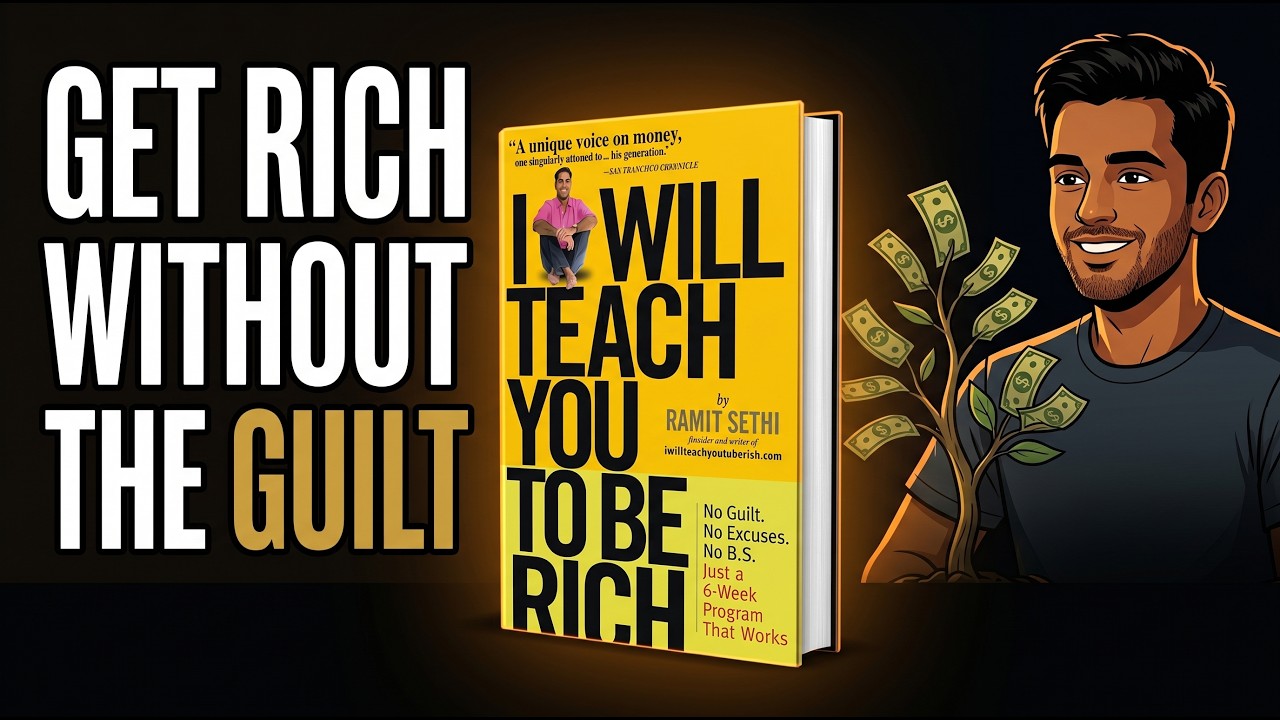
Prefer to watch? Open the animated summary on YouTube.
In one lineBuild wealth with an automatic system and a few big decisions, and spend freely on what you love instead of feeling guilty over small costs.
Key lessons
- Automate saving and investing so the right things happen without willpower.
- Spend consciously: spend generously on what you love and cut hard on what you do not.
- Put your energy into big wins like income, investing early and big costs, not tiny expenses.
- Invest early, simply and cheaply, and let compounding work for decades.
- Fix the basics: avoid fees and pay credit card bills in full.
- Define what a rich life means to you, and point your money at it.
- A good-enough plan that you start today beats a perfect plan you never begin.
On this page (8 sections)
Every month, your salary arrives. A few days later it is mostly gone. You promise yourself to save more next month, maybe to skip the weekend outings or track every rupee. The effort lasts a week or two, and then life takes over. After a while, you feel guilty and stop looking at your account at all.
I Will Teach You to Be Rich by Ramit Sethi offers a different path. He says you do not need to become a strict budgeter. You need a good system, a few big decisions and the freedom to spend on what you truly enjoy.
What is I Will Teach You to Be Rich about?
Ramit Sethi is an American writer and money coach. He first published this book in 2009. A second edition came out in 2019. It is framed as a six-week plan, with the steps in a clear order.
Sethi’s central idea is that money problems are mostly about behaviour, not knowledge. Most people know they should save and invest. They just do not do it, because willpower runs out. So he asks you to design your money life so that the right actions happen on their own.
This matters now because spending is easier than ever. One tap on your phone can send money away in a second. A system that works in the background is a strong defence.
How does automation help?
The first move is to automate your money. When your salary arrives, a fixed amount moves on its own to savings, to investments and to bills. What remains is yours to spend.
Say you earn a salary in Hyderabad. On the day after payday, an auto-debit sends a set amount into a mutual fund SIP, another into an emergency fund, and the rest of the bills are paid. You do not decide each month. You decided once.
This removes the battle with temptation. The saving takes place before you can spend the money or talk yourself out of it. Sethi argues that this one step does more than years of trying to be disciplined.
What is conscious spending?
Most advice tells you to cut everything. Sethi says the real aim is to spend consciously. Choose a few things you love and spend on them without guilt. Cut hard on the things that mean little to you.
If you love travel, put real money there. If you do not care about a new phone every year, skip it. The point is that your spending matches your values.
This also changes how it feels. You are not denying yourself. You are choosing. A person who enjoys a good trip and drives an old car can be much happier than a person who spends a little on everything and enjoys none of it.
Why focus on the big wins?
Sethi dislikes endless worry about small costs. He argues that stressing over a daily coffee brings little saving and a lot of guilt. Meanwhile, the choices that matter get ignored.
The big wins in his view are:
- automating savings and investing,
- raising your income by negotiating your pay,
- keeping big recurring costs under control,
- starting to invest early.
For example, getting a ten per cent raise at your next review may do more than five years of skipping small treats. Spend your limited attention on these few moves.
Invest early and keep it simple
On investing, Sethi’s message is calm. You do not need to pick stocks or time the market. He suggests regular investing in low-cost, broadly spread funds, and leaving the money for decades.
The key is time. Money invested at 25 has many more years to grow than the same money invested at 35. Compounding means that your gains also earn gains, so the early years count most.
The book is written for readers in the United States, so its account names and tax rules do not carry over to India. The principles do. In India, the same ideas might mean low-cost index funds, a regular SIP and a simple emergency fund. Check the rules and costs for the product you choose.
Fix the basics, define your rich life, and start
Sethi also covers the plumbing. Avoid fees that quietly eat your returns. Pay your credit card bill in full each month, so you never pay interest. Choose accounts that serve you.
Then he asks a personal question: what does a rich life mean to you? For one person it is travel. For another it is time with family or the freedom to help parents. Your money should fund that picture.
His last lesson is to start. Many people wait until they understand everything. Sethi says a plan that is good enough and running beats a perfect plan that never begins.
How to use this at work and at home
- Set up an automatic transfer for the day after your salary arrives. Start small if you must.
- Write down the three things you love spending on. Increase that budget without guilt.
- List the costs you do not care about. Cancel at least two, such as an unused subscription.
- Start a simple SIP in a low-cost fund. Do not wait until you know everything.
- Pay credit card bills in full, and prepare one salary-negotiation talk for your next review.
Our take
The strongest part of the book is the idea of design over willpower. Automation is easy and works. Conscious spending is also a kind and realistic message, and it helps readers who feel shame about money.
There are weak points. The “don’t worry about small costs” message can be taken too far. If your income is low or your debts are high, small costs matter a great deal. The book assumes you have some spare money to automate, and for many households that is not true yet. Its advice on accounts and credit is also built around the United States.
The negotiation scripts can feel too pushy for some workplaces. Treat them as ideas to adapt, not rules. Even so, as a simple first system for a new earner, it is a good and encouraging start.
The animated summary goes through each idea with stories and examples. It takes about 18 minutes.
Who should read I Will Teach You to Be Rich?
Young professionals and first-time earners who feel guilty or confused about money, and anyone who wants a simple system instead of strict budgeting.
Watch the full animated summary
Every idea from I Will Teach You to Be Rich, told as a story in about 18 minutes.
As an Amazon Associate, we earn from qualifying purchases.