The Simple Path to Wealth Summary: Spend Less, Invest the Rest
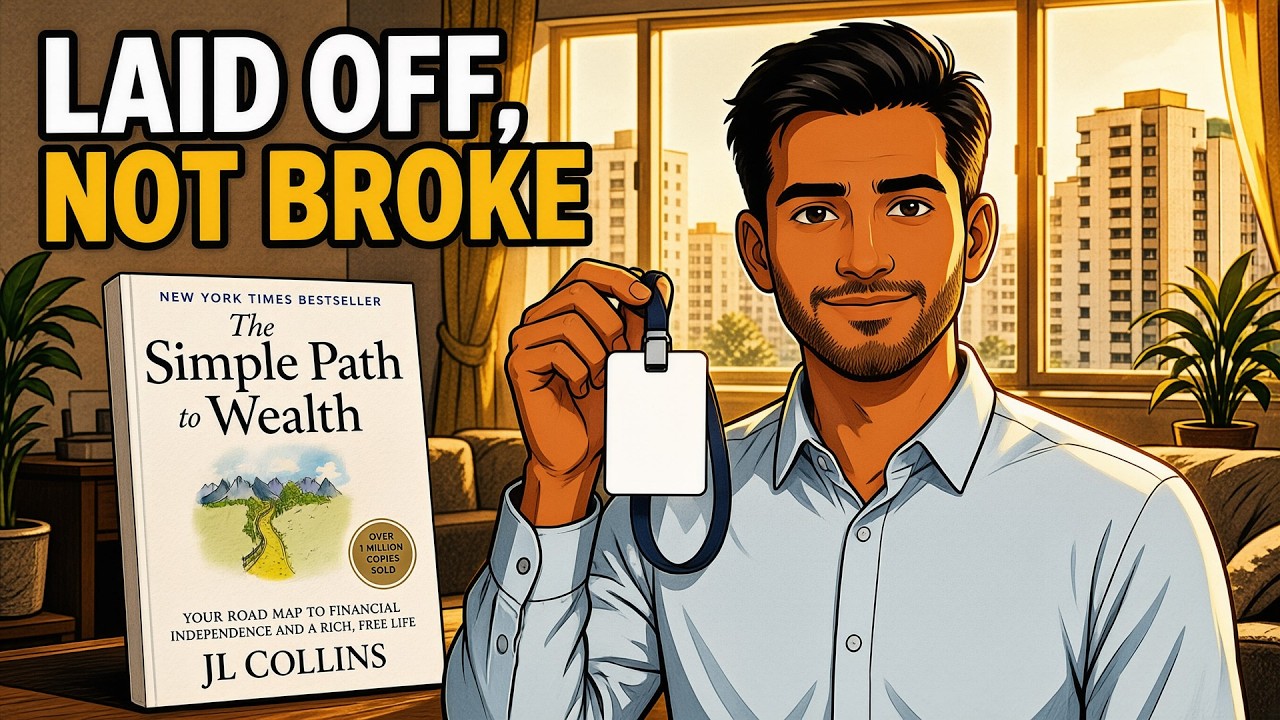
Prefer to watch? Open the animated summary on YouTube.
In one lineSafety is not a bigger salary. It is money that keeps working for you, and the nerve to leave it alone when markets fall.
Key lessons
- A high salary does not protect you if your spending rises to match it.
- Debt ties you to your paycheck. Clear it first, starting with the highest interest rate.
- Ask what your money can earn, not only what it can buy.
- Walk-away money gives you room to say no to a bad job or a bad boss.
- Markets crash often, and the real danger is selling in a panic.
- Keep investing simple: one low-cost fund that buys a broad market, held for years.
- When you can live on about 4% of your investments a year, you are financially free.
On this page (8 sections)
A layoff email lands on a Tuesday. Your card bill is due on the fifth. Your car loan and phone EMI are due too. In that moment, you learn whether your salary was your safety or your chain.
The Simple Path to Wealth by JL Collins is a book about making that moment less frightening. It does not teach you to earn more. It teaches you to need your salary less.
What is The Simple Path to Wealth about?
JL Collins is an American writer. He first wrote these ideas as letters to his daughter, then turned them into a blog series and a book. The book was published in 2016, and a revised edition followed later.
His central idea is that wealth comes from a few simple habits. Spend less than you earn. Avoid debt. Invest the difference in a simple, low-cost fund. Then leave it alone for years.
This matters today because money advice is often noisy. Apps, tips and “experts” push complicated choices. Collins argues that complexity mostly helps the seller.
Why a bigger salary does not save you
Collins tells of a friend who complained that he could not manage on a year-end bonus of $800,000. He was spending more than $175,000 every three months. The point is that high earners can go broke, while people on lower pay can reach financial freedom. It has less to do with what you earn than with what you value.
Collins uses a hard name for the person whose lifestyle always matches their income: a “gilded slave.” Picture a team lead in Bengaluru. Salary lands on the first. By the eighth, most of it is gone to a card, a car loan and a phone EMI.
Why debt comes first
Collins says debt makes you a slave to whatever income you have. Each payment needs the next salary, so you cannot leave a bad job. He calls paying off debt your top priority.
He gives a rough guide. Pay off debt slowly if the interest is under 3%. Use your judgement from 3% to 5%. Above 5%, pay it off as fast as you can. List your debts by rate. Pay the minimum on all, and put every spare rupee on the highest rate.
In our own reading, a credit card that charges 30% a year or more is an emergency.
Why money should work for you
Collins points to the boxer Mike Tyson, who earned hundreds of millions of dollars and ended up bankrupt. His view is that Tyson saw money only as something to buy things with. Collins asks you to see what it can earn, and then what those earnings can earn.
Collins has a blunt name for this money. Here we call it walk-away money. It is not cash in a drawer. It is saved and invested money. Collins’s first walk-away money was half a year’s pay. When his boss refused a four-month leave, he resigned. His boss then offered six weeks. Money gave him room to bargain.
Why the market is not a casino
Collins believes the American stock market has risen over the long run, through many disasters. He describes the daily moves as foam on a glass of beer. The beer is the thousands of businesses you own. The foam is the daily price noise that scares people.
He learned the cost of fear himself. In the 1987 crash, the market fell more than 22% in one day. Collins held for some months, then sold near the bottom. He later bought back in at a higher price. He calls it expensive and stupid.
Collins expects big crashes from time to time, and he says your money may be cut in half more than once. The crash is not the danger. Selling is.
Keep it simple
Collins is hard on paid advisers. He quotes the finding that over twenty years, 83% of actively managed American share funds failed to beat the plain market index. He praises index funds, which simply buy the whole market at very low cost.
His rule for the building years is to buy a broad, low-cost fund and not tinker with it. He also suggests saving as much as you can, promising future raises to your investments, and making the investing automatic.
For the end goal, he uses the 4% guide. When you can live on 4% of your investments each year, you are financially free. That is about 25 times a year’s spending. He calls it only a rule of thumb.
How to use this at work and at home
- List every debt with its interest rate. Clear the costliest first.
- Keep your lifestyle flat. When a raise arrives, send it to investments before it reaches your account.
- Set an automatic monthly transfer on salary day into a broad, low-cost fund. Check fees and tax rules in India first.
- Decide now what you will do in a crash. The best answer is often nothing.
- Count your cushion in months of spending. Aim to grow it a little each year.
Our take
The strongest part of this book is its clear order of steps: debt, then habit, then nerve. The advice to ignore noise is hard to follow, but it is wise. The story of Collins’s own mistake in 1987 makes the lesson real.
There are weak points. The book is written for the United States, and its fund examples do not carry over directly to India. Costs, tax rules and fund choices differ, so check them before you act. The claim that the market always goes up is a view about the past, not a promise. Saving half your income is also not possible for many families. And simple advice is not the same as advice made for your case.
Still, the main message works anywhere. Clear your debts, spend less than you earn and give your money time.
The animated summary shows these ideas through a software team lead in Bengaluru. It takes about 19 minutes.
Who should read The Simple Path to Wealth?
Salaried professionals who worry about layoffs, carry card or loan payments, and want a plain plan for investing without paying for complicated advice.
Watch the full animated summary
Every idea from The Simple Path to Wealth, told as a story in about 19 minutes.
As an Amazon Associate, we earn from qualifying purchases.