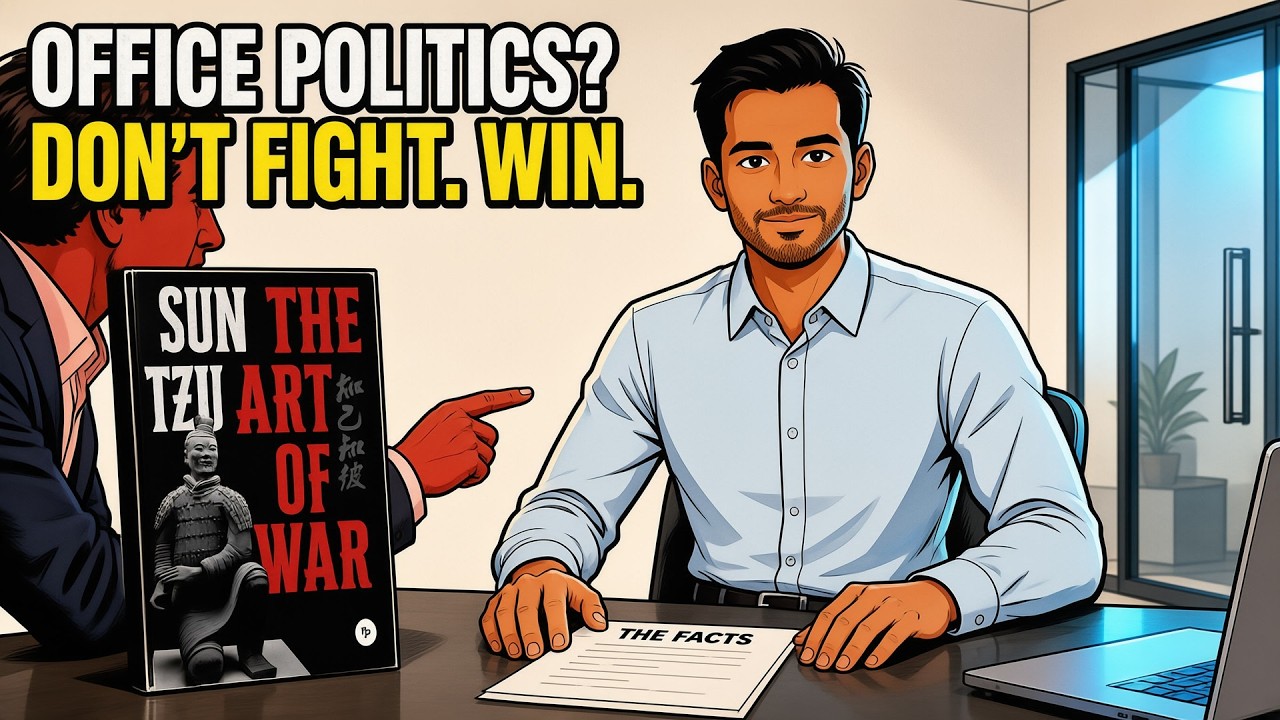
The 33 Strategies of War Summary: Handle Office Politics

Prefer to watch? Open the animated summary on YouTube.
In one lineTreat work as a campaign: keep your real goal in view, stay calm, refuse fights and sides that only help others, and learn to see a friendly saboteur.
Key lessons
- Your most dangerous enemy at work is often a friendly colleague, not an open rival.
- Watch for three signs together: unusual friendliness, sudden secrets and too much praise of you.
- A win that costs you goodwill and time can be as bad as a loss.
- Stay calm when others try to provoke you. Their goal is a reaction.
- Write down a real goal. Most office fights look pointless next to it.
- Refuse to be pulled onto anyone's side. Build alliances on shared interest, not shared mood.
- Put decisions in writing, and recognise dirty moves without copying them.
On this page (8 sections)
You finish a big project. In the review, your numbers appear on a colleague’s slides, under his name. He smiles at you afterwards and calls it teamwork. You feel angry, but you also feel foolish, because he has been your friend for months.
The 33 Strategies of War by Robert Greene says this is not bad luck. It is a war you did not know you were in. Greene argues that the hardest fights at work are with people who seem to be on your side. His advice is to see the game clearly and to act with a plan, not with anger.
What is The 33 Strategies of War about?
Robert Greene is an American author. He published this book in 2006, after The 48 Laws of Power. The book studies war through stories of generals, kings, boxers and business people. From them, it draws 33 strategies for daily life.
Greene’s central idea is that most of us are prepared for peace but not for the conflict we actually face. We treat office life as a friendly space. Others treat it as a contest for power.
The book also has a darker side. It teaches offensive and sometimes ruthless tactics. The episode summarised here reads the book mainly for defence. The aim is to see these moves when they are used on you, not to use them yourself.
Why your worst enemy may be a friend
Greene tells the story of John McClernand, a general in the American Civil War. He was charming, and he knew President Lincoln. He served under Ulysses Grant, and he envied him. He passed Grant’s plans to Washington as his own and criticised Grant behind his back.
Greene lists three warning signs of this kind of person: unusual friendliness, a sudden urge to share secrets, and too much praise of you to others. Any one sign means little. All three together deserve a closer look.
Greene adds a brake. He wants clarity, not suspicion of everyone. The signs are a reason to watch, never a reason to attack.
Think of a manager in Mumbai who gets a daily visit from a cheerful colleague. The colleague asks about deadlines and shares gossip about other teams. Months later, the same colleague presents the manager’s forecast. The signs were there. They looked like friendship.
Why winning every fight can ruin you
Greene retells the story of King Pyrrhus, who beat Rome twice. Each win cost him his best soldiers. He said another such victory would ruin him. We now call this a Pyrrhic victory. It is a win that costs too much.
At work, the cost is time, goodwill and a new enemy who wants revenge. Say you correct a colleague in front of the whole team and you are right. The room still turns cold. You may be called “difficult” by evening, and he gains a story to tell about you.
The book also warns about anger. Greene points to the boxers Muhammad Ali and Joe Frazier, who fought three times and were never the same. Calm is a strength. Your opponent wants you to react, so a quiet reply takes away the prize.
Why you should take no side
Greene tells of Murray Bowen, a family therapist. His relatives were fighting over the family business, and each wanted him on their side. Bowen refused every alliance. When someone passed him gossip, he answered neutrally or took it back to the person it was about. The feud settled.
Greene separates two kinds of alliance. A false alliance forms from an emotional need, such as shared anger at the boss. A true alliance forms from shared interest, such as two teams that need each other’s data. The first breaks easily. The second lasts.
Why you need a real goal
Greene says that “get promoted” or “have less stress” are wishes. A real goal is clear, detailed and rooted in reality. For example, “lead the analytics team within one year.”
With a goal written down, you can test each fight. Does it move you closer? Most office quarrels fail that test.
Know the other person, and keep a paper trail
Greene shares the warning of William Macnaghten, a British envoy in Kabul in 1839. He ignored many warnings because he assumed the Afghans saw things as he did. He was killed in 1841. Greene’s lesson is that every person is like a foreign culture. Ask what the other person needs and fears.
He also shares the habit of the officer John Boyd, who asked for risky orders in writing. At work, this is a short email after a meeting: what was decided, who does what, and whose work it is.
How to use this at work and at home
- Write your real goal for the next twelve months in one sentence. Test your next conflict against it.
- Watch for the three signs together. Note them. Do not act on one sign alone.
- Send a short recap email after each important meeting.
- When someone invites you to complain about a colleague, decline kindly. Take no side.
- When you win, give the other person a way to save face. Greene shows that people you crush quietly become people who work against you.
Our take
The strongest part of this book is its range of stories. They are memorable, and they make a hard point clearly: anger and pride lose more battles than skill does. The advice to stay calm, keep a goal and keep records is useful for almost any job.
There are weak points. Greene’s examples come from generals and politicians, and an office is not a battlefield. Treating every colleague as a possible enemy can make you cold and tired. The book’s offensive chapters also teach manipulation, which many readers will not want to use. In some workplaces, speaking up directly to a manager or to HR is the better and braver choice.
Take the defensive half, which is clear and practical. Leave the rest on the shelf.
The animated summary tells these stories with a worked example from a Mumbai office. It takes about 20 minutes.
Who should read The 33 Strategies of War?
Anyone who is good at the work but unsure about the people, especially professionals who have been blamed, overlooked or pulled into office gossip.
Watch the full animated summary
Every idea from The 33 Strategies of War, told as a story in about 20 minutes.
As an Amazon Associate, we earn from qualifying purchases.