Sapiens Summary: How Shared Stories Run the World
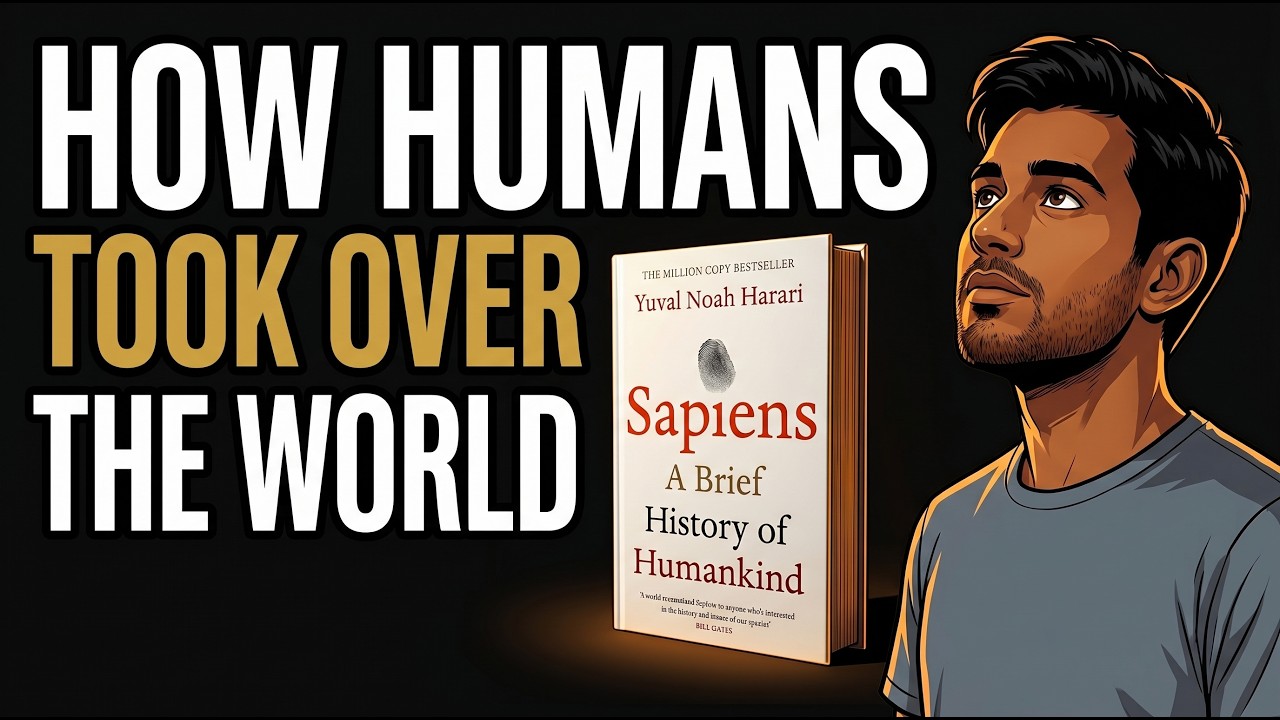
Prefer to watch? Open the animated summary on YouTube.
In one lineHumans rule the world because we cooperate in huge numbers by believing shared stories like money and nations, yet more power has not clearly made us happier.
Key lessons
- Humans won by flexible cooperation in large groups, not by strength or lone genius.
- Our key ability is to believe shared fictions such as money, nations, laws and companies.
- These imagined orders are not lies, but they are not natural facts either.
- The farming revolution grew our numbers, but it often made daily life harder for ordinary people.
- Money, empire and religion slowly joined separate cultures into one connected world.
- Modern science began when people admitted they did not know.
- More power does not mean more happiness. Ask what your goals are for.
On this page (10 sections)
You work hard for a number in a bank account. The number is not food, and it is not a roof. Yet you trust it, and so does everyone else. Why does this work?
Sapiens by Yuval Noah Harari gives a bold answer. He says humans can believe in things that exist only in our shared minds, and that this ability explains our whole history. It also changes how you see your job, your money and your goals.
What is Sapiens about?
Yuval Noah Harari is an Israeli historian. He wrote Sapiens: A Brief History of Humankind, first published in Hebrew in 2011 and in English in 2014. The book tells the story of our species from its early days to the present.
Harari groups that story into three big turning points. The Cognitive Revolution is when human minds changed. The Agricultural Revolution is when people began to farm. The Scientific Revolution is when people learned to admit ignorance and chase knowledge and power.
This matters now because we live with fast change in technology and work. Seeing how we got here helps you think more clearly about where we may go.
Why cooperation, not strength, made us rule
Long ago, humans were one kind of animal among many. We were not the strongest or the fastest. One person alone loses to a lion.
What set us apart was cooperation. Bees and ants also work in large numbers, but in fixed ways. Humans can change plans and work together in flexible ways, even with strangers, and in huge groups.
So power has always been collective. The real question is how millions of people who never meet can still work toward one goal.
The power of shared stories
Harari’s answer is shared fiction. Around seventy thousand years ago, he says, human minds gained the ability to imagine things that do not exist in the physical world. We could talk about gods, spirits and rules that nobody had ever seen.
A shared story can tie strangers together. People who believe in the same nation, the same god or the same laws will trust each other, even if they have never met.
Think of a big company. The company cannot be touched. It is a set of agreements. Yet thousands of people turn up each morning because they all believe in it.
Money, nations and laws are imagined orders
Harari calls these shared fictions imagined orders. Money is the clearest case. A banknote is only paper. It works because everyone agrees it has value.
The same is true for borders, brands, laws and titles. They are not lies, because they change what people really do. But they are not facts of nature either.
This view helps in daily life. Your salary grade, your company’s rules and your social status all depend on shared belief. You can take them seriously and still ask which ones are worth your effort.
Was farming a trap?
Harari makes a bold claim here. About twelve thousand years ago, people started to farm. We usually tell this as a story of progress. He says that for the average person it was a step down.
Farming made more food in total, so populations grew. But farmers often worked harder than hunter-gatherers, ate a less varied diet, caught more diseases and faced famine when crops failed. In his words, wheat tamed us as much as we tamed wheat.
The lesson goes beyond history. Growth in the total is not always better for each person. When you hear that output or profit is up, ask who gains and who pays the cost. A company may grow while its staff work longer hours.
How money, empire and religion joined the world
For a long time, people lived in many separate cultures. Harari says three forces slowly joined them. Money let strangers trade across borders. Empires brought different peoples under shared laws and language, often by force. Universal religions spread common beliefs across large populations.
Each of these rests on shared belief. Each widened the circle of cooperation. This helps explain how we arrived at today’s linked world.
Science began with “we do not know”
Harari says that for most of history, people felt that the important knowledge was already known, held in tradition and sacred texts. Modern science began when people admitted ignorance and went looking for answers by observation and experiment.
He adds that science grew together with capitalism and empire. Science created new powers, money funded the search, and empires spread the results.
For you, the lesson is personal. Saying “I do not know” is not weakness. It is where learning starts.
Are we happier?
After all this progress, are people happier? Harari doubts it. Our expectations rise as our lives improve, and we get used to comfort. Gains in power are larger than gains in happiness.
He also looks ahead with worry, to a future where biology and technology may let us change humans themselves. His question is whether we know what we want before we gain that power.
How to use this at work and at home
- See the imagined orders. List the titles, targets and status symbols that rule your week. Ask which ones deserve your energy.
- Give your team a story. People cooperate around a clear purpose. Explain why the work matters, not just what to do.
- Ask “better for whom?” When a change is called progress, ask who gains and who carries the cost.
- Watch your expectations. Before you chase the next promotion or purchase, ask if it will really last, or if you will adjust within months.
- Say “I do not know.” Use it in meetings and then find out. It builds trust and learning.
Our take
The strongest part of this book is its sweep. It links money, work, belief and happiness into one picture, and the idea of shared fictions is a useful lens for office politics, branding and even personal goals. The farming chapter also makes you question simple stories of progress.
There are weak points. Some historians and scientists say that Harari states big claims with more certainty than the evidence allows, and that he simplifies complex periods. The “history’s biggest fraud” line about farming is a strong view, not settled fact. Much of the book is argument and storytelling, not proof. And the happiness section raises hard questions but gives few clear answers.
So read Sapiens as a thought-provoking guide, not as the final word on history. It is best when it makes you ask better questions.
The animated summary walks through each idea in a clear order. It takes about 16 minutes.
Who should read Sapiens?
Curious readers who want the big picture of human history, and professionals who want to understand why money, brands and institutions hold so much power.
Watch the full animated summary
Every idea from Sapiens, told as a story in about 16 minutes.
As an Amazon Associate, we earn from qualifying purchases.