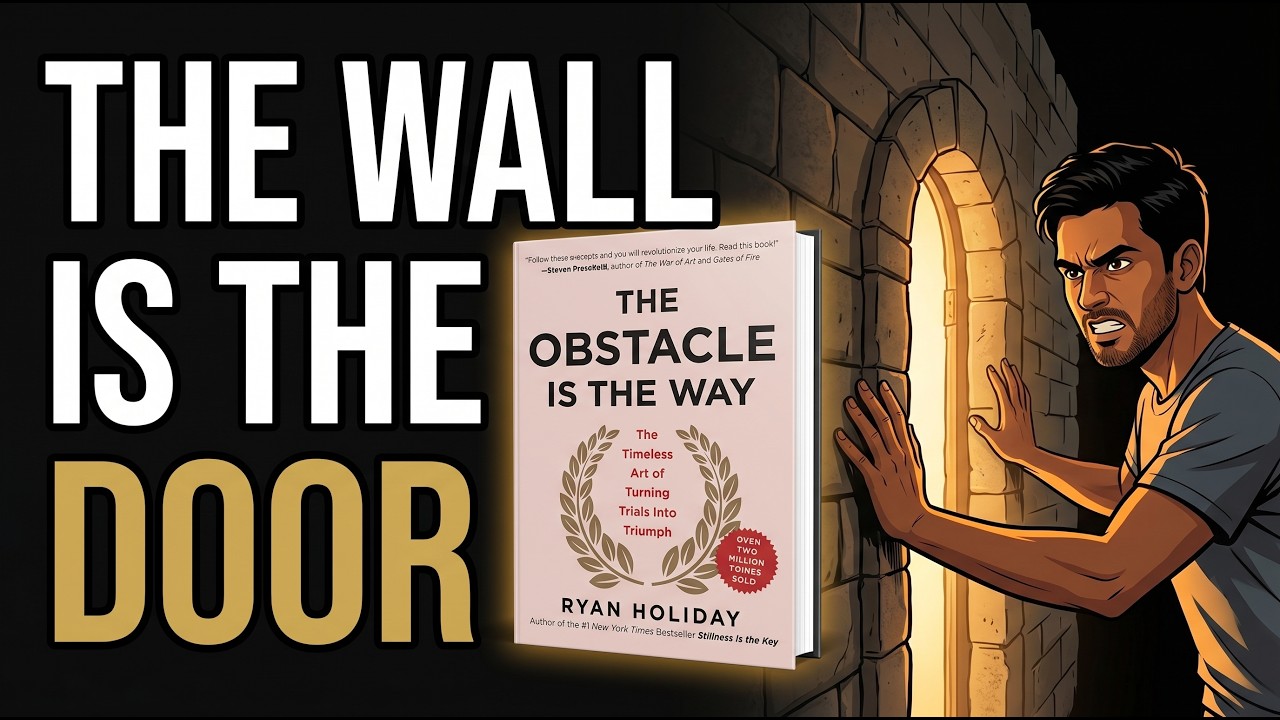
The Obstacle Is the Way Summary: Turn Setbacks Into Strength
Prefer to watch? Open the animated summary on YouTube.
In one lineThe thing blocking your path can also be the path, if you meet it with clear perception, steady action and a will that endures.
Key lessons
- Every obstacle holds a hidden opportunity. Ask what it makes possible.
- Panic makes problems look bigger. Stay calm and look at the plain facts.
- Spend your energy only on what you can control, and let the rest go.
- Act now with what you have. Treat each failure as feedback and try again.
- Look for a way to use the obstacle itself, not just get past it.
- When you cannot remove a problem, endure it with dignity and do not let it break you.
- Difficulties build your strength and skill for the next challenge.
On this page (8 sections)
Something is in your way right now. It could be a project that stalled, a client who left, or a door that closed. Most of us treat this as the enemy. We complain, we get angry, and we wait for better conditions before we move.
The Obstacle Is the Way by Ryan Holiday offers a different view. The thing that blocks you is not only a problem. It can also be the route forward, if you know how to meet it.
What is The Obstacle Is the Way about?
Ryan Holiday is an American writer who has written many books on Stoicism, a practical philosophy from ancient Greece and Rome. He published this book in 2014. The title comes from a line often linked to the Roman emperor Marcus Aurelius: what stands in the way becomes the way.
Holiday studied people who faced heavy obstacles and still came out stronger. They shared one habit. They treated difficulty as raw material to work with, not as a reason to quit.
He sorts their approach into three parts: perception, action and will. Perception is how you see the problem. Action is what you do about it. Will is how you endure what you cannot change. The sections below follow that order.
Why every obstacle hides an opportunity
We are taught to see obstacles as purely bad. Holiday asks you to look again. The same situation that blocks you may also push you to be creative, to grow, or to find a better path than the easy one.
This does not mean pain is unreal. It means pain is not the whole story. A failed pitch teaches you what the client really wants. A closed door can force a better one open.
When you meet a problem, ask: what could this make possible that an easy road never would? That one question shifts you from feeling stuck to looking for options.
Control your perception first
Obstacles are often neutral. Fear, panic and anger make them feel bigger. Holiday says the first job is to steady your mind.
Imagine you learn that your biggest client is leaving. The first wave of emotion says, “We are finished.” A calmer look says, “We lose one source of income, and we have other work.” The facts are the same. Only the second view lets you plan.
So separate the real problem from the dramatic story around it. Then ask what is within your control. You cannot control that the client left. You can control who you call tomorrow and how you improve your service. Put your effort there, and let go of the rest.
Act, and keep acting
Clear thinking is not enough. Obstacles fall to action. Holiday praises steady, creative effort. Do not wait for perfect conditions, because they rarely come.
Break the large problem into the next small step, and take it. If it fails, treat that as information. Adjust and try another way. Few walls fall to a single push, but many fall to repeated, changing attempts.
A shop owner whose sales drop might not wait for the market to recover. She could call ten old customers this week, offer a new service next week, and keep what works. Movement beats worry.
Use the obstacle itself
The most striking idea in the book is that you can use the obstacle as a tool. A limit forces creativity that plenty never would. A failure shows a weakness you can now fix.
Think of a team with a tiny budget. It cannot buy ads, so it writes better emails and builds trust one customer at a time. The limit shaped a stronger habit. Holiday asks: how can this setback become the reason I succeed?
The will to endure
Sometimes you see clearly, act hard, and the obstacle still stays. Illness, loss and other people’s choices cannot always be fixed. Here Holiday turns to will, which is the inner strength to accept what you cannot change without being broken by it.
This is not giving up. It is resilience. You accept reality, keep your dignity, and decide how you will respond. The outer battle may be lost, but the inner one is yours to keep.
Holiday also notes that difficulty builds you. A life with no obstacles would leave you untested. Each problem you meet well makes you more able for the next one.
How to use this at work and at home
- Name the obstacle in one plain sentence, with no drama. For example: “The project is two weeks late.”
- Write two lists: what you control and what you do not. Start only with the first.
- Pick the next small action and do it today, even if you do not feel ready.
- Ask one question about the problem: “What could this teach me, or let me do, that I could not do before?”
- For what you cannot change, decide how you will respond, such as staying calm in the next meeting or asking for help.
Our take
The strongest part of this book is its simple structure. Perception, action and will give you three questions to ask in any crisis. It is easy to remember and easy to use. The book also shows that calm thinking is a skill you can practise.
There are weak points. Many stories in the book are about famous winners. We hear less about people who did everything right and still failed, so the message can sound too hopeful. Turning every setback into a gift can also hurt when the loss is real, such as a death or a long illness. In those cases the will section matters most, and rest and support matter too.
The book is a good start for anyone who panics easily, and a useful reminder for those who do not.
The animated summary walks through each idea with stories. It takes about 12 minutes.
Who should read The Obstacle Is the Way?
Anyone facing a setback at work or at home, such as a lost job, a blocked project or a failed plan, who wants a calm and practical way to respond.
Watch the full animated summary
Every idea from The Obstacle Is the Way, told as a story in about 12 minutes.
As an Amazon Associate, we earn from qualifying purchases.