The Compound Effect Summary: Why Small Choices Win (Darren Hardy)
Prefer to watch? Open the animated summary on YouTube.
In one lineSmall daily choices, repeated for a long time, multiply into big results, good or bad, so change the small things you do every day.
Key lessons
- Small actions do not just add up. They multiply, but the results stay hidden for months.
- Big dramatic changes usually collapse. A change so small it looks like nothing can last.
- Track one area for a week. What you record, you face. What you estimate, you flatter.
- A strong reason, your why, and clear values give you fuel when willpower runs out.
- Remove triggers and props for a bad habit, add a replacement, and tell someone to hold you accountable.
- Keep your rhythm. Momentum builds from an unbroken streak, even a five-minute version.
- Do a little more after you hit the wall, because that is where most people stop.
On this page (9 sections)
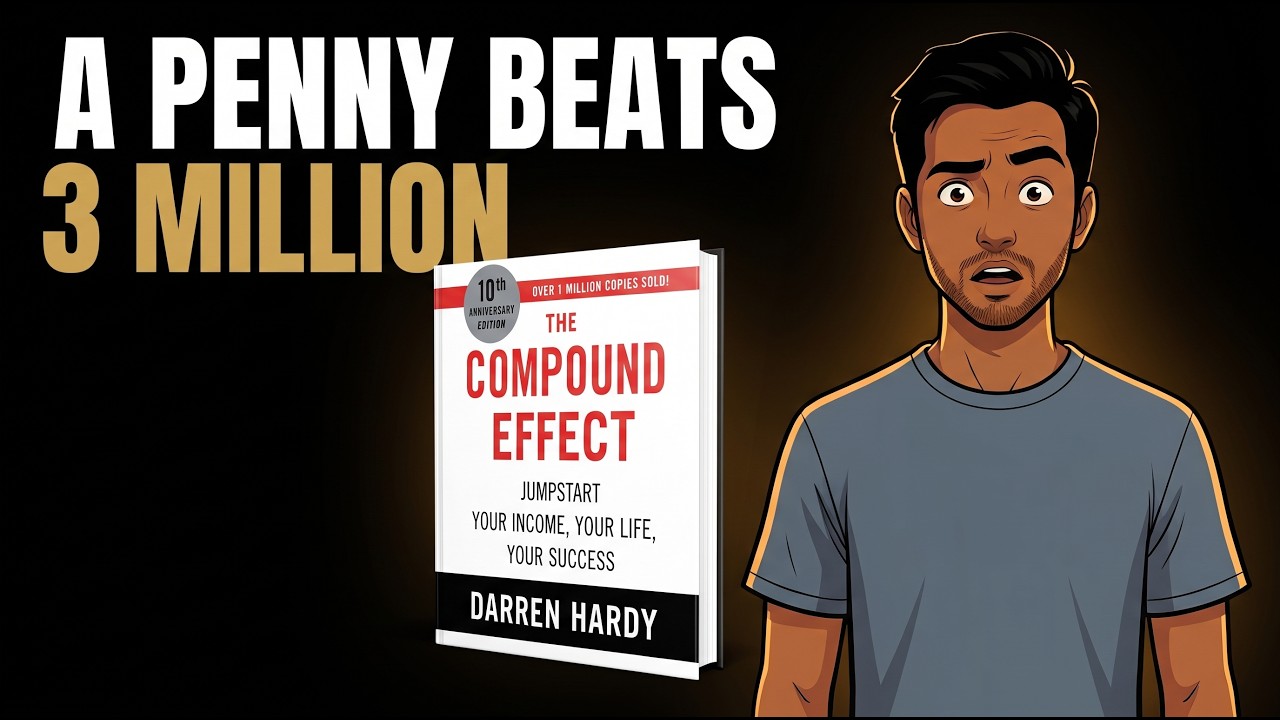
Imagine a choice. You can take three million dollars in cash today. Or you can take one penny that doubles every day for 31 days. Most people take the cash. But the penny grows to more than ten million dollars.
There is a trap in the story, though. On day 20, the penny is worth only about five thousand dollars. The person who chose it feels foolish for almost the whole month. This is the shape of most big results in life, and it is why many people quit too early.
What is The Compound Effect about?
Darren Hardy is an American author who was the publisher of SUCCESS magazine for many years. He published The Compound Effect in 2010.
The main idea is blunt. Success does not come from big, dramatic moves. It comes from small daily choices that repeat for a long time. The same math can also build a problem. A small bad habit, repeated daily, grows in the same way.
This matters today because we live with quick-fix ads and 30-day challenges. Patient daily work feels slow next to them. Hardy says the slow way is the one that works.
Small choices multiply
Cut 100 calories a day, which you would barely notice, and in a year you may lose around five kilos. Read thirty minutes a day, and in a few years you will know more about your field than most colleagues.
Nothing looks special on any single day. Yet the result is big. Hardy gives three reasons why few people live this way. The results are hidden for months. The work is dull, like making the same small deposit again and again. And we are used to quick fixes, so slow growth feels like losing.
The effect is also running right now, whether you plan it or not. Every small choice is a deposit in an account you cannot close.
Why dramatic change fails
The common plan is a grand gesture, such as a new gym plan, a harsh diet, or a 5 a.m. routine from tomorrow. It feels serious. But it asks for huge willpower every day, and willpower runs out. After a few missed days, shame arrives and the plan dies.
Hardy suggests a change that looks too small, kept up for a very long time. Walk for twenty minutes after dinner. Read ten pages at night.
Small promises also build identity. Each day you keep one, you become a person who keeps promises. Picture two colleagues in January. One joins a costly gym, goes eleven days, and stops. The other walks every evening and is still walking in December.
Track it so you can see it
The most practical tool in the book is free. Choose one area to change, and write down every action in it for a week. This could be every rupee spent, every snack eaten, or every hour online.
Do not judge and do not change anything yet. Just record. Many people are surprised. The person who thinks he rarely snacks sees a daily pile of small bites. Another person finds where her salary leaks.
Write it down because memory negotiates and paper does not. Ask yourself which area you would least like to check. That is probably the place to start.
Hardy also says you are fully responsible for how you respond to your situation. You may not control what happens, but you control your reply. Tracking is that responsibility put on paper.
Find your fuel: your why and your values
Two people start the same routine on the same day. Ninety days later, one has changed and one quit in week three. The plan was the same. The reason was different.
Willpower fades, so you need a reason with weight. “I want to be fit” is light. “I want to be healthy enough to enjoy my daughter’s wedding” can carry you through a cold morning.
Your core values act as a filter. If one of your values is that family dinners come first, you do not struggle over a late meeting that could be an email. Spend ten minutes writing three lines: what I want, why I want it, and what I will not trade for it.
Tools for habits
To end a bad habit, Hardy offers five moves:
- Find the trigger, such as a time, place, mood or people.
- Remove the props from your space. If the snack is not at home, you will not eat it.
- Add a replacement. Give the late scrolling a book, and the snack a walk.
- Ease out of deep old habits in steps.
- Know yourself. Some people do better by stopping all at once.
To build a good habit, use accountability. Tell one person exactly what you will do each day and ask them to check. A goal known only to you can quietly die. A goal shared with someone you respect has a social cost if you skip it.
Build momentum, and go past the wall
Hardy calls momentum “Big Mo”. At first, every good choice feels like pushing uphill. After weeks of repeating it, the routine begins to pull you.
Strong morning and evening routines help most. The middle of your day belongs to meetings and other people. The edges of the day belong to you. Consistency matters more than intensity. If you stop for three weeks, you start the uphill push again. Even a five-minute version on a bad day keeps the streak alive.
Every long effort also hits a wall. This is the point where you feel done. Hardy says growth lives right there, because most people stop before it. One more call, one more revision or one better-prepared meeting brings returns far larger than the effort.
How to use this at work and at home
- Pick one tiny change that takes under twenty minutes a day. Do it for ninety days.
- Track one area for seven days, such as spending or screen time. Do not judge it yet.
- Write your why and your top three values on one page.
- Tell one friend or colleague your daily action. Ask them to check on you weekly.
- Build an evening routine: five minutes to log your day, five minutes to prepare tomorrow, and some time to read instead of scrolling.
Our take
The strongest part of the book is its simple message that small things add up. The advice on tracking and on a short evening routine is easy to use and costs nothing. The penny story is a clear way to explain why patience pays.
There are weak points. Many ideas are not new, and the book repeats them in a motivational tone. Some claims, such as luck being mostly preparation, ignore the unfair starts that many people face. Compounding also does not work if your basic needs are not met. A person with long work hours and little rest may find daily habits hard.
Even so, if you start strong and then fade, the book gives you a calm, slow way to keep going.
The animated summary walks through each idea with stories. It takes about 18 minutes.
Who should read The Compound Effect?
Professionals who start strong and lose steam, and anyone who wants steady progress in work, money or health without a big overhaul.
Watch the full animated summary
Every idea from The Compound Effect, told as a story in about 18 minutes.
As an Amazon Associate, we earn from qualifying purchases.