
Lakshman Rekha Is Not in Valmiki's Ramayana: Who Drew It?
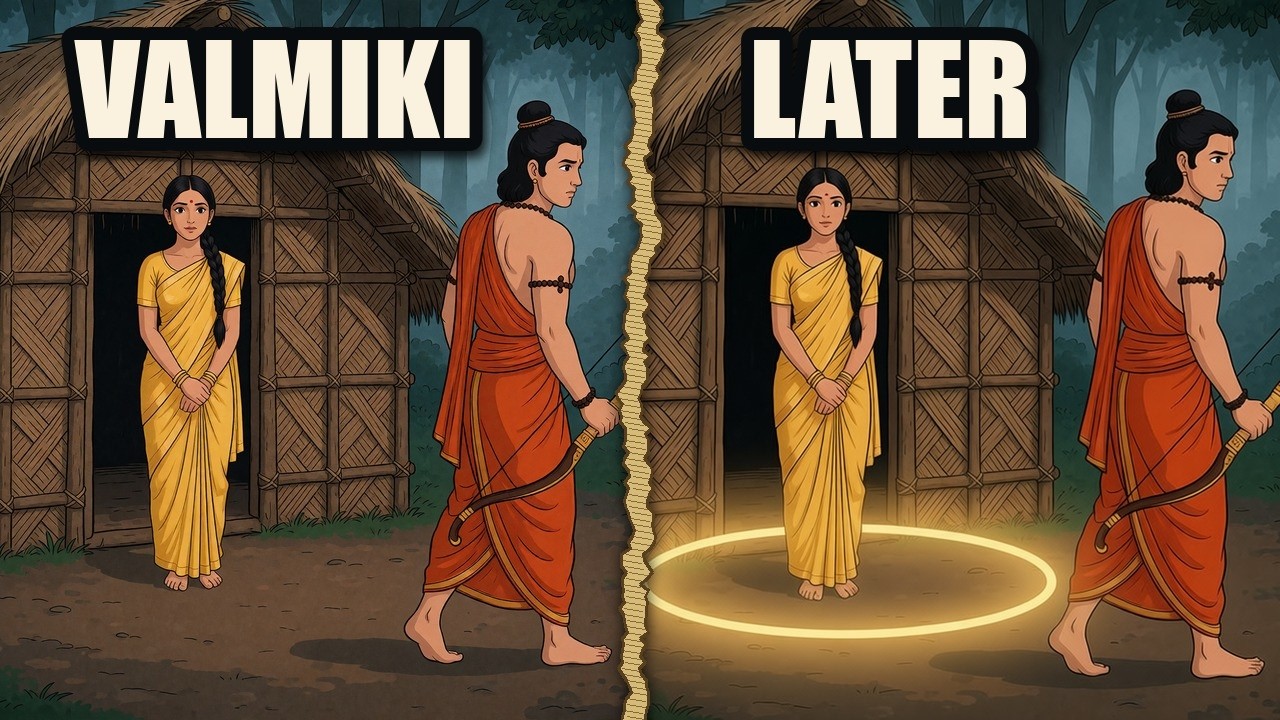
Prefer to watch? Open the animated summary on YouTube.
In one lineMany loved Ramayana scenes, from the Lakshman Rekha to Shabari's tasted berries, come from later tellers, not from Valmiki's poem.
Key lessons
- In Valmiki, Lakshmana blesses Sita and leaves. He draws no line around the hut.
- The line first shows up in later tellings, and each hand drew it a little differently.
- In Valmiki, Ahalya lives unseen under a curse. The stone version comes later.
- Valmiki's Shabari offers fruit. The tasting of each berry comes from Priyadas.
- Tulsidas, Kamban and the Adhyatma Ramayana each retold the story for their own age.
- Later poets and folk singers added stories too, such as Urmila's long sleep and the squirrel's stripes.
- Ask which poet is speaking when you hear a Ramayana story. A later story is not a wrong one.
On this page (8 sections)
Your grandmother told you about the Lakshman Rekha at bedtime. A circle around a hut, a warning not to step out, and Ravana waiting outside. It may be the most famous line in any story told in India. One day you will tell it to a child.
Yet if you open Valmiki’s Ramayana, the line is not there. This page asks where it came from. It also looks at six other scenes that people think are from Valmiki but are not. Nothing here takes away the Ramayana you love. These later tellings were made for good reasons, and millions love them.
What is this episode about?
Valmiki’s Ramayana is the oldest telling we have. Tradition calls it the adi kavya, the first poem. It has seven books, each called a kanda. This episode compares it with later tellers, and at each stop it asks who told the story and what it did for its own age.
Some scholars think Book 7 was added later, and some think Book 1 was too. This page treats both as part of the Valmiki text as it has come down to us. It ranks no telling above another.
The Lakshman Rekha
In Book 3, Lakshmana hears Sita’s anger and leaves her. He blesses her and asks the forest gods to guard her. He draws nothing.
The line appears much later. In Tulsidas’s Hindi poem, Ravana’s wife Mandodari mocks him. She says Lakshmana drew a little line, and Ravana could not even cross that. That is all. Tulsidas never tells the scene itself, which is odd. His English translator, Growse, noticed this in 1883.
So the line was already travelling in older tellings. The oldest traces we found are in a Ramayana in the Khotanese language, dated by one scholar to the ninth century, and a Sanskrit play. A Telugu poem has Lakshmana draw seven lines. In one telling it is a taunt. In another it is a guard. No single poet drew it. Each hand drew it for its own time.
Ahalya and the boatman
Many TV shows picture Ahalya as a woman turned to stone until Rama’s foot touches her. In Valmiki she is not stone. Her husband, the sage Gautama, curses her. She lives unseen, with air as food and ashes as a bed. When Rama arrives, the two princes clasp her feet.
The stone version appears in the Adhyatma Ramayana, written around the fifteenth century. It is a poem of bhakti, which means loving devotion, and it pictures Rama as God. Its next chapter has a boatman who will not let Rama into his boat until he washes his feet. If Rama’s feet turn a stone into a woman, what will they do to a wooden boat? The ferry is his living, so his worry makes sense.
Tulsidas later moves the boatman to the exile crossing. You can love Rama in both tellings.
Shabari and the tasted berry
In Valmiki, Shabari is a woman in the forest near Lake Pampa. She gathers fruit from the trees and offers it to Rama. The poem never shows her tasting it.
The tasting comes later. A poem from Odisha hints at it. Rama asks why she did not mark the mangoes with her teeth. Priyadas, who wrote about saints around 1712, tells it plainly. She tastes each berry so that Rama gets only the sweetest. In that story, the offering shows love.
Urmila, the squirrel and the name on the stones
Urmila is Sita’s sister and Lakshmana’s wife. In Valmiki, she gets a wedding and a mention. The story that she slept for all fourteen years comes from a Telugu women’s song called Urmiladevi Nidra. In the song, she and Lakshmana swap sleeping and waking hours so that he can stay awake for Rama. The song has no known date.
The bridge to Lanka has its own set of additions. Valmiki gives it stones, hills and machines. In Tulsidas, Nala and Nila build it, and a mountain floats by Rama’s greatness. We found no early text that says Rama’s name was written on each stone. The squirrel with three stripes first appears in the Telugu Ranganatha Ramayana, as far as we could find. A Tamil hymn uses a squirrel only as a comparison.
Other well-known scenes
Tulsidas’s wedding scene differs from Valmiki’s. In Valmiki, kings fail to lift the bow of Shiva and besiege the city. In Tulsidas, Rama and Sita first meet eyes in a flower garden, before any test of strength.
The Shiva Tandava Stotram, a hymn credited to Ravana, is also not in Valmiki. The word tandava does not appear in his poem. The hymn’s last verse names its singer as the ten-faced one, which is the hymn’s own claim.
Kamban, a Tamil poet of about the twelfth century, gives the king Vali a boon that takes half the strength of anyone who faces him. In Valmiki, Rama has to explain his hidden arrow after the shot. In Kamban, the fight is already uneven.
Some scenes are Valmiki’s own. The golden deer, with drops of living gold on its sides, is in Book 3. Hanuman’s mace is another matter. In Valmiki he snatches up an iron beam at the grove gate. The only mace tied to him there is Kubera’s, in Book 7.
How to use this at work and at home
- When you hear a Ramayana story, ask which poet is speaking.
- Check whether a scene is in Valmiki, and who told it first.
- Ask what a later teller wanted to say to their age.
- Share the source with family, gently. A later story is not a wrong one.
- Read one canto of Valmiki yourself with the family, and compare it with the TV version.
What this means today
The strongest point of the episode is its respect. It does not mock any belief. It shows that the Ramayana is a living tradition, passed from singer to singer like a family recipe. The TV serial and the Ramlila are hands in that chain too.
The page also says plainly where evidence is thin. The oldest written traces of the line are a matter for scholars, and some dates come from one survey. Sources like these are useful but not final.
If you hold the story sacred, nothing here asks you to change that. It only asks you to know which voice you are hearing. The Ramayana you know is not wrong. It is later.
The animated episode gives the book, canto and teller for every scene. It takes about 19 minutes.
Who should read Valmiki Ramayana: The Lakshman Rekha and Other Later Stories?
Anyone raised on TV serials, bedtime stories and festival plays who wants to know which scenes come from Valmiki and which came later.
Watch the full animated summary
Every idea from Valmiki Ramayana: The Lakshman Rekha and Other Later Stories, told as a story in about 19 minutes.


