
Influence Summary: The 6 Principles of Persuasion
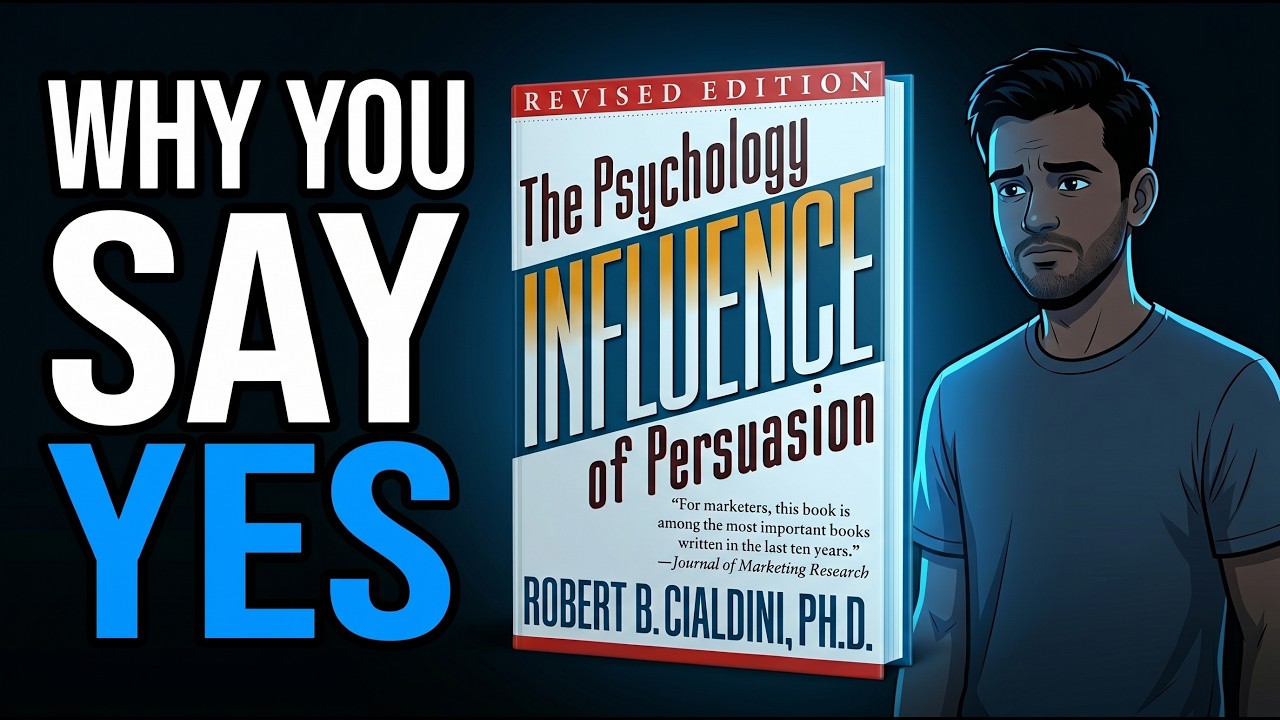
Prefer to watch? Open the animated summary on YouTube.
In one lineA few automatic mental shortcuts drive most of our yes decisions, and when you can spot them, you can persuade honestly and stop being pushed around.
Key lessons
- Much of what you decide is automatic. You react to cues before you think.
- Reciprocity: a small favour or gift creates a strong urge to give something back.
- Commitment and consistency: after a small yes, a bigger yes feels natural.
- Social proof: you copy what many other people seem to be doing.
- Liking, authority and scarcity also push you: you say yes to people you like, to experts, and to things that are running out.
- The same principles can help people or trick them. Honesty and intent make the difference.
- When you feel sudden pressure to say yes, pause and judge the request on its merits.
On this page (9 sections)
- What is Influence about?
- Why you do not always think before you decide
- Reciprocity: why a small gift creates a big debt
- Commitment and consistency: how a small yes leads to a big one
- Social proof: why you follow the crowd
- Liking, authority and scarcity
- The same tools can help or harm
- How to use this at work and at home
- Our take
Think of the last time you said yes when you wanted to say no. Maybe you bought something you did not need. Maybe you agreed to extra work because a colleague asked nicely. Afterwards, you could not say why.
Influence by Robert Cialdini explains why this happens. Your mind uses quick shortcuts to decide, and these shortcuts can be triggered on purpose. If you know the triggers, you can use them fairly and also protect yourself.
What is Influence about?
Robert Cialdini is an American psychologist. He studied for years how people get others to say yes. He also spent time inside the world of sales and marketing to see the methods up close. His book Influence was first published in 1984 and is still one of the best-known books on persuasion.
His central idea is that persuasion is not random. It follows a small set of principles. He calls them weapons of influence, because in the wrong hands they can be used to manipulate.
This matters today because every app, advert and sales call is built to press these buttons. Knowing them is a basic life skill.
Why you do not always think before you decide
The first idea is the base for all the others. You face too many choices each day to think deeply about each one. So your mind uses rules of thumb. When a certain cue appears, you react in a set way.
Most of the time this works well. It saves time and effort. The problem is that an automatic reaction can be set off by someone who knows the cue. You act on autopilot, and only later wonder why you agreed.
This is not a weakness to be ashamed of. It is how every human mind copes. But it means that believing “I am never fooled” is the surest way to be fooled.
Reciprocity: why a small gift creates a big debt
When someone does something for you, you feel you must return it. This urge is very strong. Most people dislike being in debt, and they often give back more than they received.
That is why a free sample, a small favour or a surprise gift so often leads to a sale. Picture a vendor who hands you a free taste of a sweet. You feel awkward walking away without buying.
Used well, reciprocity is just generosity. Help a colleague first, share what you know, and give without keeping score. Goodwill usually comes back. When you are on the receiving end, you can accept kindness warmly and still say no to the request that follows.
Commitment and consistency: how a small yes leads to a big one
People want to be consistent, and to look consistent. Once you take a stand, especially in public or in writing, you feel pressure to stay with it. Changing your mind feels like admitting you were wrong.
So a small first agreement makes a larger request easier to accept. Someone asks you to sign a short form “just to show support”. Later they ask for your time or money, and saying no would feel inconsistent with your earlier yes.
You can use this for good. Write down your goals and tell a friend. The wish to be consistent then helps you follow through. But when a small yes seems to be leading somewhere bigger, stop and ask if the bigger request is good for you.
Social proof: why you follow the crowd
When you are unsure, you look at what others do. If many people choose something, you assume it must be right. A long queue outside a restaurant makes the food look better. Five-star reviews do the same for a product.
Often the crowd is right, so this shortcut is useful. But a crowd can also be wrong, and numbers can be made to look bigger than they are.
If you want to persuade, show true evidence that real people were glad they made the same choice. If you are being persuaded, ask a plain question: is this right for me, or am I just following?
Liking, authority and scarcity
Cialdini describes three more triggers, and each one is easy to spot once you know it.
Liking. You say yes more easily to people you like. We tend to like people who look like us, who praise us, and who work with us towards a shared goal. A salesperson who suddenly shares your hometown, your school and your taste in cricket is using this. Enjoy the warmth, but judge the request on its merits.
Authority. You tend to follow experts. The trouble is that signs of expertise, such as a title, a uniform or a confident voice, can work even when the person is not an expert in the matter at hand. Look past the costume to the facts.
Scarcity. Things look more valuable when they are rare or about to end. “Only two rooms left” or “offer ends tonight” creates urgency, and urgency cuts short your thinking. Ask yourself whether you want the thing itself, or whether you are only afraid of missing out.
The same tools can help or harm
One idea runs through the whole book. These principles are neutral. A doctor who shows real credentials uses authority honestly. A seller who invents a fake deadline uses scarcity dishonestly. The tool is the same. The honesty behind it is different.
How to use this at work and at home
- Give first. Share a useful tip, make an introduction or offer help before you ask for anything.
- Ask for small, real commitments. Ask a team to agree on one clear step in writing, then build from there.
- Show true proof. Use honest results, real customer feedback and real numbers. Never inflate them.
- Earn your authority. Build real skill and let it show through your work, not through titles.
- Pause before you say yes. When you feel sudden pressure, wait one day if you can. Then decide on the merits.
Our take
The strongest part of this book is its clarity. Six principles are easy to remember, and each one explains many everyday moments. The idea that awareness is your best defence is both simple and useful. Cialdini also takes care to say that these tools can be used fairly, which makes the book more than a trick manual.
There are limits. The book is based on studies from social psychology, and some well-known findings in that field have not always held up when repeated. So treat the principles as strong tendencies, not as laws that work on every person every time. Culture and context also matter. A tactic that works in one country or workplace may fall flat in another. Finally, knowing a trigger does not make you immune. You may still feel the pull. The skill is to notice it and pause.
If you work in sales, management or marketing, or you simply want to stop saying yes by reflex, this book is worth your time.
The animated summary walks through each principle with clear examples. It takes about 18 minutes.
Who should read Influence?
Anyone who has said yes and regretted it, and anyone in sales, management or marketing who wants to persuade people in an honest way.
Watch the full animated summary
Every idea from Influence, told as a story in about 18 minutes.
As an Amazon Associate, we earn from qualifying purchases.


