
How to Stop Worrying and Start Living Summary: Carnegie's Toolkit
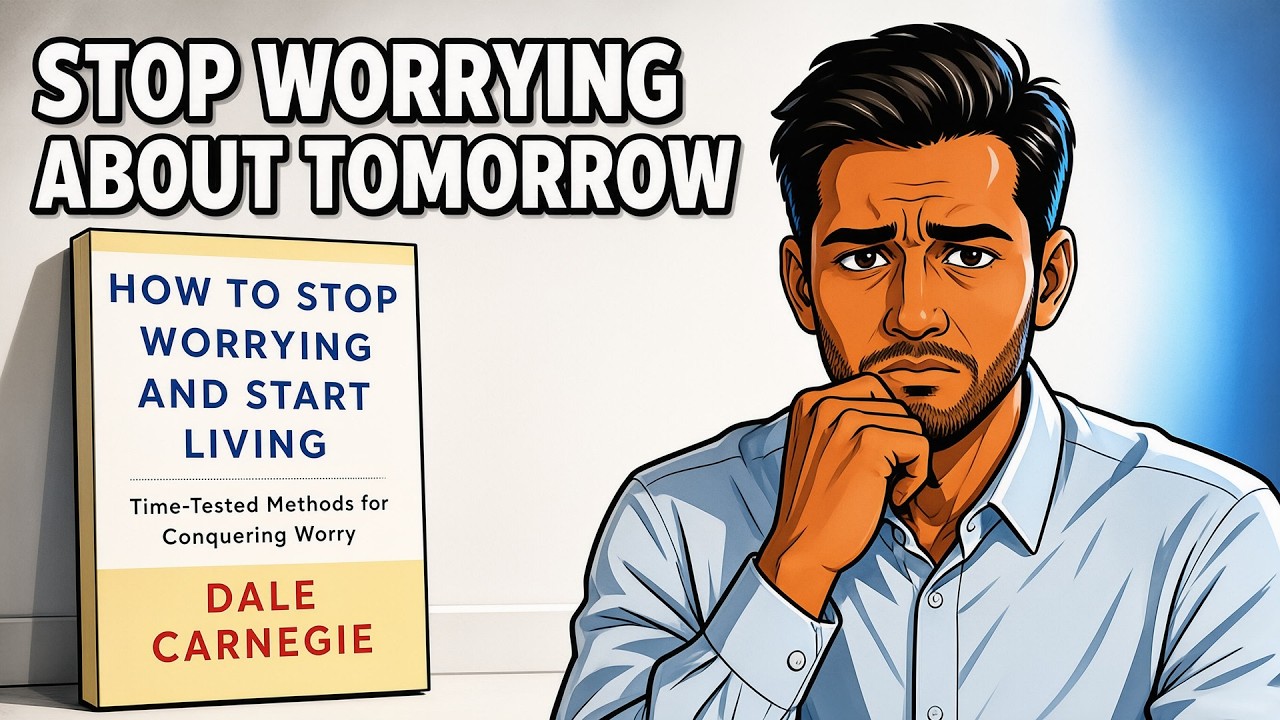
Prefer to watch? Open the animated summary on YouTube.
In one lineWorry goes round in circles and concern takes the next step, so face the worst, check the odds and live one day at a time.
Key lessons
- Shut the iron doors on yesterday and tomorrow, and live in day-tight compartments.
- Concern takes steps to meet a problem. Worry goes round in futile circles.
- Get the facts before you decide. Half the worry in the world comes from deciding without them.
- Write down your worry and ask two questions: what am I worried about, and what can I do?
- Ask what is the worst that can happen, accept it, then work calmly to improve on it.
- Check the odds. The law of averages kills many worries.
- Put a limit on worry, and close the desk when work is done.
On this page (9 sections)
It is Sunday night. Monday’s review is a day away, but you have already held it in your head all evening. You tell yourself you are being responsible. Meanwhile your home loan, your job and your boss’s last remark go round and round.
Dale Carnegie wrote a whole book on this. He does not use the word overthinking. He calls it worry, and he gives practical tools to turn it into action.
What is How to Stop Worrying and Start Living about?
Dale Carnegie is best known for How to Win Friends and Influence People. He published How to Stop Worrying and Start Living in 1948. Many stories in it came from his adult classes, which he called his laboratory. Carnegie also drew on his own hard years as a young man in New York, when he sold trucks he did not understand and came home each night with a headache.
The book is not about pretending all is well. It is a toolkit for the worry that lives in tomorrow. This page covers its main tools. The book also says that these ideas do not replace a doctor. If worry will not let go, or comes with panic or low mood, see a doctor or counsellor.
Live in day-tight compartments
The book opens with a medical student, William Osler, who was worried about exams and about earning a living. He read a line by Thomas Carlyle that told him to do what lies clearly at hand, not to stare at what lies dimly ahead.
Years later, Osler told Yale students about a ship with iron doors. Touch a button, and the past is shut out. Touch another, and the future is shut out. He called these day-tight compartments. Osler became one of the most famous doctors of his time.
This is not a rule against planning. Carnegie says to plan for tomorrow, but without anxiety, and to prepare by doing today’s work well.
Concern or worry?
Carnegie draws a clear line. Concern means seeing what the problems are and calmly taking steps to meet them. Worry means going round in maddening, futile circles.
Think of a branch manager whose regional head says, “We will discuss your numbers on Monday.” Worry is replaying the meeting at midnight. Concern is an hour with the branch report and a list of numbers he can move by Monday.
Carnegie also notes that the hours after work are the dangerous ones. Your mind has no load, so it runs faster and faster. One answer is to stay busy. Another is to remember that other people are mostly thinking about themselves, not about you.
Get the facts, then decide
Carnegie quotes Herbert Hawkes, a dean who helped about 200,000 students. Hawkes said half the worry in the world comes from deciding before you have enough facts. The method has three steps: get the facts, study them, then decide and act.
An oil man, Waite Phillips, said that past a certain point, more thinking only adds confusion. After that, you decide, act, and stop looking back. Ask yourself one question now. What fact about your biggest worry have you never checked?
Ask the two questions, and face the worst
In 1942, Galen Litchfield ran an insurance company in Shanghai under Japanese occupation. He feared a prison. On a Sunday, he typed two questions. What are you worrying about? What can you do about it? He wrote down his fear and four courses of action, and chose one. He estimated that half his worry went when he decided, and more once he started to act.
Willis Carrier, an engineer, faced a failed machine that could cost his firm $20,000. He used three steps. Ask what is the worst that can happen. Prepare to accept it if you have to. Then calmly work to improve on it. He tested the machine, found a fix, and his firm made money.
The same method works with a job. The worst may be losing it and finding another. It would hurt, but it would not end you. Accepting the worst frees energy for the problem.
Carnegie warns against stopping there. Accepting what you could still change is fatalism. While there is a chance to save the situation, fight.
Check the odds
A reader, Mrs. Salinger, worried for eleven years that she had left an electric iron on. A question from her husband ended it: what does the law of averages say? She told Carnegie that this phrase destroyed 90 percent of her worries.
Jim Grant, who shipped fruit by rail, feared train wrecks. He counted. Of about 25,000 wagons he handled, about five had been wrecked. He let the law of averages do his worrying for him. Ask for the real record at your own office too. How often does your company move a manager after one weak quarter?
Limit your worry and shut the desk
Carnegie borrows an idea from traders. A stop loss is a set point where you sell a falling share so the loss cannot grow. A worry is worth only so much fuss. He spent two years writing a novel, then learned he had no talent for fiction. He wrote off those years and never wished he were a novelist again.
Another reader, Louis Montant, shared a method from a friend. Write the worry out in detail. Put it in a drawer and read it again in two weeks. The worry often collapses like a balloon pricked with a pin.
Then there is a man named Blackwood, who listed six worries in 1943 and found the list 18 months later. None of the six had happened. As the old saying goes, today is the tomorrow you worried about yesterday.
The last idea is to close the day. A writer, Ordway Tead, called himself a great dismisser. When he shut his desk, he put every problem away. Another man learned from his wife, who sang while washing dishes because she washed only one day’s dishes at a time.
How to use this at work and at home
- Write your biggest worry on paper and answer two questions: what am I worried about, and what can I do?
- Get one fact you have not checked, such as the odds or the real record.
- Ask what the worst is. Accept it, then plan to improve on it.
- Pick one number or task you can move this week, and do it first.
- Close your laptop at a fixed time. Keep a worry drawer, and read each page again in two weeks.
Our take
The strongest part of this book is its simplicity. The two typed questions and the worst-case test are easy to try tonight, and they work by turning a loop into a step. The stories are warm, and Carnegie’s tone is kind.
The book is old, and its style is dated. Many stories come from readers, so they are not studies. The advice also fits everyday worry better than deeper anxiety. Telling yourself to “stop worrying” can feel unfair if a loan or a family illness is real. Carnegie himself says to fight when you still can. Some people will need more than a toolkit, such as a doctor’s care.
Even so, a simple method is worth more than a hard promise to stop. Pick one tool and use it this Sunday.
The animated summary follows a branch manager through one anxious quarter. It takes about 20 minutes.
Who should read How to Stop Worrying and Start Living?
Professionals who replay the boss's remark on Sunday night, or lie awake over a review, a loan or a job, and want practical tools, not slogans.
Watch the full animated summary
Every idea from How to Stop Worrying and Start Living, told as a story in about 20 minutes.
As an Amazon Associate, we earn from qualifying purchases.


