Deep Work Summary: How to Focus in a World of Distraction
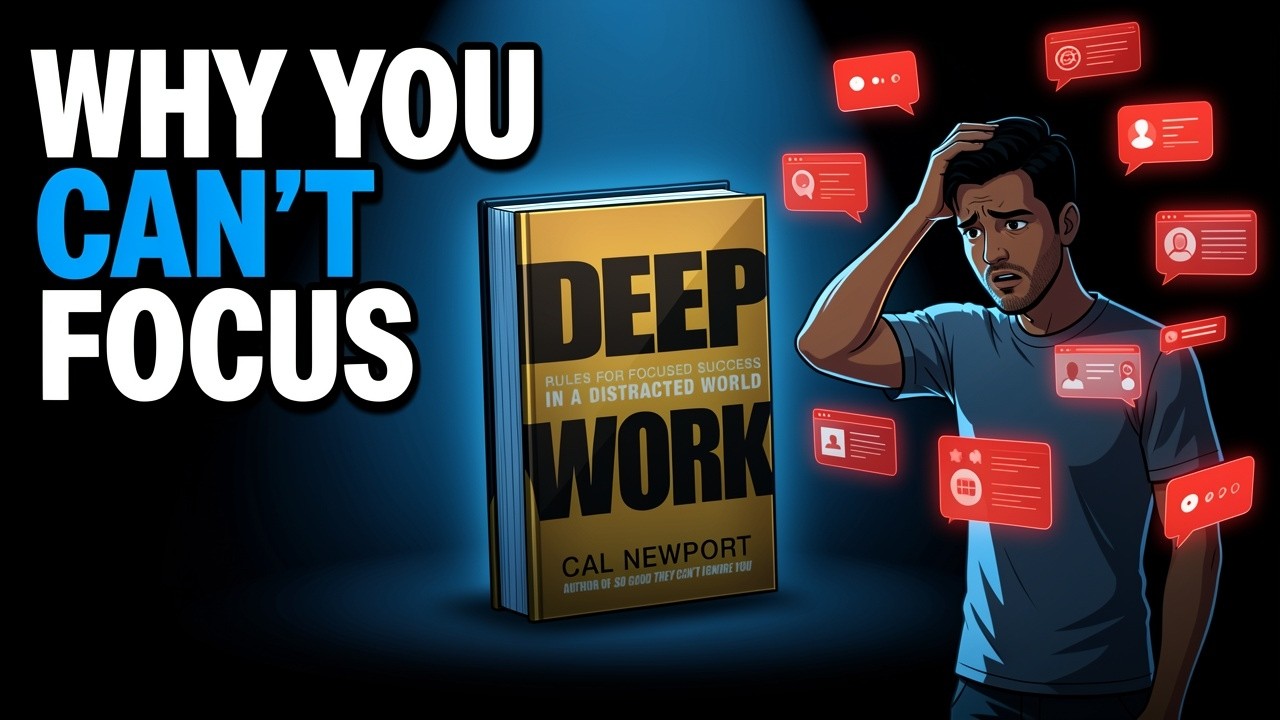
Prefer to watch? Open the animated summary on YouTube.
In one lineFocused, distraction-free work is becoming rare and valuable, so protect it with fixed blocks, fewer distractions and real rest.
Key lessons
- Deep work is focused effort without distraction that pushes your mind to its limit. Shallow work is easy and leaves little behind.
- Switching tasks leaves part of your attention behind, so every glance at a message makes the next task worse.
- Many people prefer shallow work because it looks busy and feels safe.
- Your office, phone and apps are built for constant contact, so you must set up your own defences.
- Willpower runs down during the day. Rituals and a good environment work better than discipline alone.
- Schedule deep work in advance, practise boredom, judge your tools by real benefit, and cut shallow tasks.
- End the workday on purpose. Rest is part of the work.
On this page (7 sections)
You sit down to finish the one task that matters today. You type a sentence, a notification appears, and you glance at it. Your phone buzzes. Twenty minutes later you reread a paragraph and cannot say what it means.
Deep Work by Cal Newport says this is not a willpower problem. It is a skill problem, and most of us have lost the skill. The book explains why focus matters more than ever and how to rebuild it.
What is Deep Work about?
Cal Newport is a computer science professor at Georgetown University. He published Deep Work in 2016 after years of studying how high performers organise their time.
He defines deep work as professional activity done in a state of distraction-free concentration, one that pushes your mind to its limit. This kind of work creates new value, improves your skills and is hard for others to copy.
The opposite is shallow work: answering email, sitting in routine meetings, filling forms, checking notifications. It is easy and it feels productive. But it leaves little that lasts.
Newport’s core claim is that deep work is becoming rare at the same time as it becomes more valuable.
Why deep work pays more now
Routine tasks are being automated. Newport says the people who do well in this economy can do two things. They learn hard things quickly, and they produce work at an elite level in both quality and speed.
Both skills need long, focused effort. You cannot learn a complex subject while checking your phone every few minutes. Think of a financial analyst who must build a model for a client. Two clean hours will beat a whole day of broken attention.
Why a quick glance costs more than you think
When you switch from one task to another, your attention does not fully follow. Part of it stays on the task you left. Researchers call this attention residue.
In experiments, people who were forced to switch did worse on the next task. This held even when they had finished the first one. So every look at your inbox leaves a little of your mind behind.
Picture a manager in Pune who writes a report while a chat window stays open. She replies to three messages in twenty minutes. The report takes twice as long, and she feels tired without knowing why.
Why most people stay in the shallows
Newport gives three hard truths. The first is that many people do not really want deep work. It is demanding, and it gives none of the small rewards of replies and likes.
Shallow work feels safer. When you answer messages, you look busy and your manager sees you. When you close the door and think for three hours, there is nothing to show until the work is done. Newport calls this busyness as a stand-in for productivity. When the value of your work is hard to measure, people drift towards looking productive.
The second truth is that your environment works against you. Open-plan offices, instant messaging, always-on email and addictive apps all reward quick replies. To think deeply, you have to push back on purpose.
The third truth is that willpower is limited. Each decision drains a little. By afternoon you resist distraction far less than you did at nine. So grinding harder rarely works. You need rituals and an environment that makes focus the default.
The four rules of deep work
Rule one is to work deeply. Do not wait for inspiration. Schedule your deep work blocks in advance and treat them as appointments. Newport describes four styles. The monastic style removes distraction almost fully. The bimodal style alternates long focused stretches with normal days. The rhythmic style uses the same fixed hours each day. The journalistic style fits deep work into any gap, which is powerful but takes practice.
Rule two is to embrace boredom. If you reach for your phone in every idle moment, you train your brain to crave distraction. Then your mind rebels when you try to focus. Practise standing in a queue without a screen.
Rule three is to quit social media, or be strict about it. Newport suggests a simple test for any tool. Weigh its real benefits against its real costs. Keep it only if the benefits clearly win.
Rule four is to drain the shallows. Plan your day in blocks, set limits on email, decline meetings that do not need you, and batch small tasks together.
How to use this at work and at home
- Protect one block of deep work each day, at the same time if you can. Keep your phone in another room and work on one task only.
- Turn off notifications and hide the apps that pull at you. Make distraction harder to reach than the work.
- Practise boredom. Wait for your tea or a lift without checking your phone.
- Batch email and chat into set slots, and decline meetings that have no clear purpose for you.
- Build a shutdown ritual. When work ends, stop checking email, stop replaying office talk, and say clearly that work is done.
Our take
The strongest part of the book is its honesty about why we avoid hard work. Attention residue and the idea of busyness as a stand-in for results explain a lot of modern office life. The shutdown ritual is also useful, because it treats rest as part of performance.
There are weak points. Not every job allows long blocks. A support engineer, a nurse or a junior employee may have to answer quickly, and their boss may expect it. Newport’s advice to quit social media also fits some careers better than others. The book assumes you have some control over your calendar, and many people do not.
Still, you can use the core idea even in a small way. One protected hour is better than none.
The animated summary covers each idea with stories and takes about 11 minutes.
Who should read Deep Work?
Knowledge workers, students and managers who sit down to do real work and find the day gone with little to show for it.
Watch the full animated summary
Every idea from Deep Work, told as a story in about 11 minutes.
As an Amazon Associate, we earn from qualifying purchases.